20 Healthy Habits for Busy Women and Moms That Actually Fit Into Real Life
20 Healthy Habits for Busy Women and Moms That Actually Fit Into Real Life
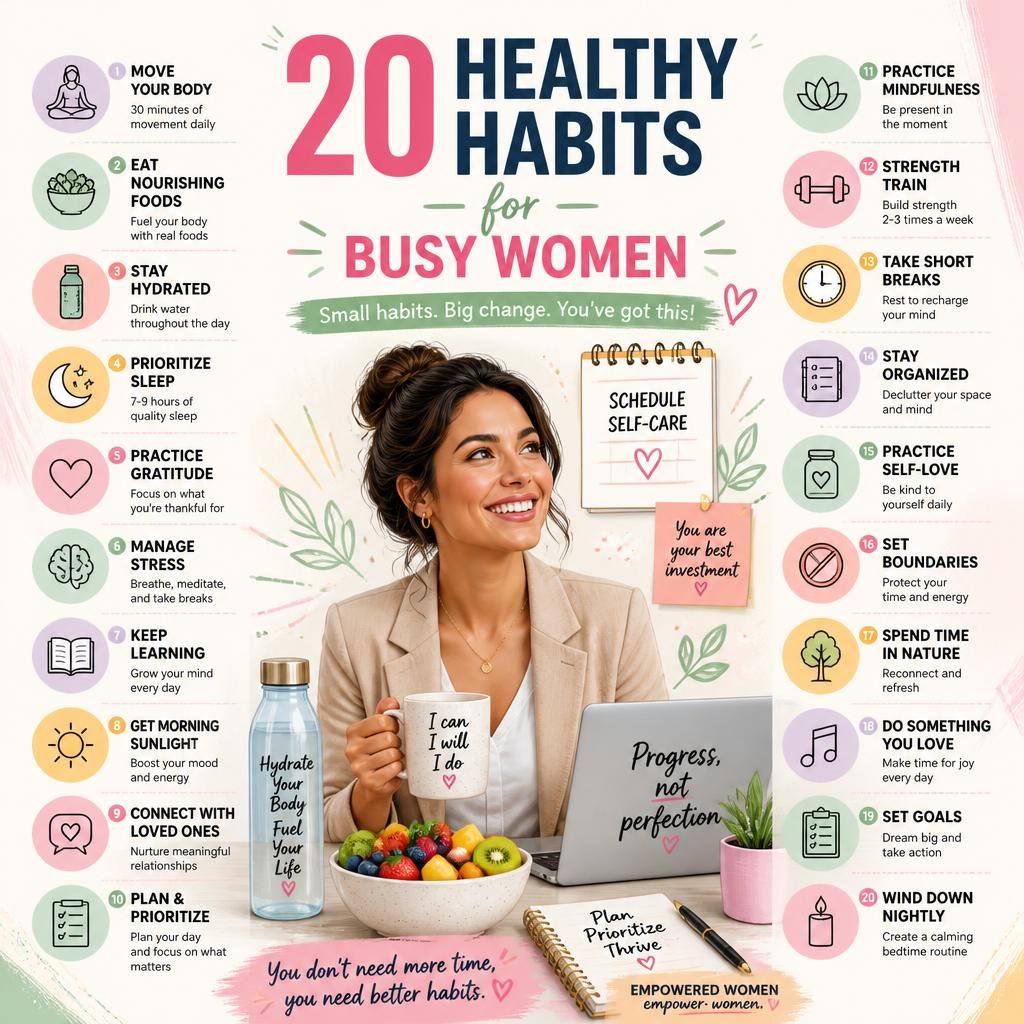
If you are a busy woman or mom, you already know the routine. You wake up before everyone else, spend the day taking care of everyone and everything around you, and collapse into bed at night having barely taken care of yourself. Sound familiar?
The problem is not willpower. The problem is not motivation. The problem is that most health advice was not designed for women who are running households, building careers, raising children, and managing the needs of everyone around them — often simultaneously.
This guide is different. These 20 healthy habits were specifically chosen because they are realistic, sustainable, and genuinely achievable for busy women and moms — even on the most hectic days.
Why Busy Women and Moms Struggle With Healthy Habits
Before we dive into the habits, let us understand why the standard health advice does not work for most women:
Time poverty is real — When you are genuinely stretched across work, family, and home responsibilities, a 60-minute gym session and an hour of meal prep feels impossible.
Energy is limited — Decision fatigue is real. After making hundreds of micro-decisions all day, choosing a salad over convenience food at 7pm requires willpower you simply do not have left.
Guilt gets in the way — Many women feel guilty spending time on themselves when there are children to care for, work to complete, or a home to manage.
All-or-nothing thinking — “I missed my workout so the whole week is ruined.” This perfectionist trap keeps women cycling between intense health phases and complete abandonment.
The solution: Habits that are so small and so well-designed that they happen automatically — without requiring significant time, energy, or willpower.
THE FUNDAMENTAL MINDSET SHIFT
Before the habits — one critical mindset shift that changes everything:
Taking care of yourself is not selfish. It is the foundation that makes everything else possible.
Your energy, patience, focus, and emotional resilience — everything you give to your family, your work, and your community — comes from your own physical and mental health reserves. When those reserves are depleted, everything suffers.
You cannot pour from an empty cup. And refilling your cup is not indulgence — it is maintenance.
MORNING HABITS (1–6)
1. The 5-Minute Morning Ritual Before Anyone Else Wakes Up
The single most impactful habit for busy moms and women is waking up even 5–10 minutes before the household chaos begins. This tiny window of quiet, uninterrupted time — before the notifications, the requests, and the needs of others — belongs entirely to you.
What to do with your 5 minutes:
- Sit quietly and breathe deeply
- Write three things you are grateful for
- Set one intention for the day
- Drink a full glass of water
- Simply sit in silence before the day begins
You do not need to wake up at 5am for this to work. Even 5 minutes before your usual alarm is enough. The point is not the duration — it is the principle of starting the day on your own terms before the world makes its demands.
Why it works: Beginning the day in a state of calm intention — rather than immediately reactive to notifications, children, or the mental load — sets a completely different emotional tone that carries through the entire day.
2. Drink Water Before Coffee
Before reaching for your first cup of coffee, drink a full glass of water. After 7–8 hours of sleep, your body is dehydrated — and dehydration is one of the most common causes of morning fatigue, brain fog, and low energy.
The habit: Keep a glass of water on your bedside table or next to the kettle. Drink it before you do anything else.
Why busy moms specifically need this: The demands of morning routines mean many women go hours without drinking water — running on caffeine and adrenaline. This creates a cycle of energy peaks and crashes that makes the day significantly harder than it needs to be.
Simple upgrade: Add a slice of lemon or a pinch of Himalayan salt for electrolytes.
3. Eat a Protein-Rich Breakfast — Even a Quick One
Many busy women skip breakfast or eat whatever their children leave behind. Starting your day without adequate protein leads to blood sugar instability, mid-morning energy crashes, increased cravings, and significantly reduced cognitive performance.
Quick high-protein breakfast options (under 5 minutes):
- Greek yogurt with berries and a handful of nuts (5 minutes)
- 2 boiled eggs prepared the night before with whole grain toast (3 minutes)
- Overnight oats with protein powder prepared the night before (2 minutes in the morning)
- Cottage cheese with fruit and seeds (2 minutes)
- A protein smoothie (3 minutes in a blender)
The key insight: Preparing breakfast the night before completely removes the morning decision and effort. You just open the fridge and eat.
Why it matters: Women who eat a protein-rich breakfast eat significantly fewer calories throughout the day, experience more stable energy, and make better food choices — all without effort or willpower.
4. Move Your Body for Just 10 Minutes in the Morning
The idea that exercise requires 45–60 minutes in a gym is one of the biggest myths preventing busy women from staying active. Research consistently shows that 10 minutes of intentional movement every morning provides substantial health benefits — and for busy women, consistency matters far more than intensity.
10-minute morning movement options:
- A brisk walk around the block
- A quick YouTube yoga or stretching routine
- 10 minutes of bodyweight exercises (squats, push-ups, lunges, planks)
- A dance session in the kitchen while making breakfast
- 10 minutes of jumping jacks, high knees, and stretching
The compound effect: 10 minutes of daily movement is 60 hours of exercise per year — significantly more than the person who attempts hour-long sessions twice a week and frequently skips them.
Practical tip: Keep your workout clothes ready the night before. The less friction between waking up and moving, the more consistently it happens.
5. Take Your Daily Supplements
Many busy women are deficient in key nutrients — particularly Vitamin D, magnesium, iron, and omega-3 fatty acids — because the demands of a busy life leave little time for nutritionally complete meals every day.
Most important supplements for busy women:
- Vitamin D — deficiency is extremely common, linked to fatigue, low mood, and weakened immunity
- Magnesium — critical for energy, sleep quality, stress management, and over 300 body processes
- Omega-3 (fish oil) — reduces inflammation, supports brain health and mood
- Iron — particularly important for women of menstruating age; deficiency causes fatigue and poor concentration
- Vitamin B complex — supports energy production and nervous system health
The habit: Keep supplements next to your coffee maker or water glass. Take them at the same time every morning so it becomes automatic.
Always: Consult your doctor before starting supplements, especially if pregnant, breastfeeding, or on medications.
6. Review Your Top 3 Priorities for the Day
Before diving into your phone, email, or to-do list, spend 2 minutes identifying the three most important things you need to accomplish today. Everything else is secondary.
Why this matters for busy women: Without clear priorities, busy days fill up with reactive tasks — responding to everyone else’s urgency rather than working on what actually matters most to you. By the end of the day, you have been busy all day but nothing truly important got done.
The simple question: “If I could only accomplish three things today, what would make the biggest difference?”
Write them down. Protect time for them. Everything else gets done around them — not instead of them.
NUTRITION HABITS (7–10)
7. The Sunday Meal Prep Habit — Even Just 30 Minutes
Full Sunday meal prep is not realistic for every busy mom. But even 30 minutes of basic preparation on Sunday evening makes the entire week significantly healthier and less stressful.
What 30 minutes of meal prep can produce:
- A large pot of grains (brown rice or quinoa) that serves as a base for 5 days of meals
- A batch of boiled eggs for quick breakfasts and snacks
- Chopped vegetables ready for salads and stir-fries
- Overnight oats prepared in 5 jars for the week’s breakfasts
- A big batch of soup or stew that provides 4–6 portions of lunch or dinner
The impact: Having healthy food ready removes the daily decision of what to eat and eliminates the “I am too tired to cook so I will just order pizza” moments that derail healthy eating.
Start even smaller: If 30 minutes feels like too much, start with just one thing — prepare 5 jars of overnight oats. That is 5 healthy breakfasts in 10 minutes. Build from there.
8. The Two-Vegetable Rule
Every dinner includes at least two vegetables. Not one. Two. This single rule, applied consistently, transforms the nutritional quality of your family’s diet without complicated meal planning or recipe changes.
How to implement it practically:
- Always have a bag of frozen vegetables in the freezer — they cook in 3 minutes in the microwave
- Keep cherry tomatoes and cucumber on the counter for zero-effort salad components
- Add spinach or kale to any pasta sauce, soup, or stir-fry — it wilts and disappears
- Roast a tray of mixed vegetables on Sunday to use throughout the week
Why two instead of one: One vegetable is easy to overlook or minimize. Two vegetables make vegetables a genuine part of the meal rather than a token side.
9. Keep Healthy Snacks Ready and Unhealthy Snacks Out of Reach
The snacks in your kitchen are the snacks you will eat. This is not about willpower — it is about environment design. Make the healthy choice the easy choice by preparing it in advance.
Healthy snacks to prepare and keep accessible:
- Boiled eggs (make a batch on Sunday)
- Cut vegetables in a container at eye level in the fridge
- A bowl of mixed nuts on the counter
- Greek yogurt portions ready to grab
- Apple slices with almond butter
- Energy balls made in batches
The rule: If unhealthy snacks must be in the house (for children’s treats, etc.) — keep them out of sight and out of easy reach. What you see, you eat. What requires effort, you skip.
10. Drink a Glass of Water Before Every Meal
Research shows that drinking a glass of water before each meal reduces calorie intake at that meal by 75–90 calories — without any dieting, calorie counting, or restriction. Over a full day, that is 200–270 fewer calories consumed effortlessly.
It also prevents the common confusion between hunger and thirst — many instances of snacking are actually thirst in disguise.
The practical habit: Keep a full glass of water on the table at mealtimes. Drink it before you start eating. Make it as automatic as sitting down.
MOVEMENT HABITS (11–13)
11. Walk Whenever Possible — Make It Your Default Transport
Walking is one of the most accessible, sustainable, and genuinely effective health habits available. It requires no equipment, no gym membership, no childcare, and can be incorporated into activities you already do.
Ways busy moms can walk more:
- Walk the children to school instead of driving
- Take a 10-minute walk during your lunch break
- Walk to the grocery store or shops when practical
- Take the stairs every single time — no exceptions
- Park at the furthest spot from the entrance
- Walk while on phone calls instead of sitting
- Evening family walks after dinner
The goal: 7,000–10,000 steps per day. A fitness tracker or your smartphone’s step counter makes this easy to monitor and motivating to achieve.
The underrated benefit for moms specifically: Walking outdoors reduces cortisol, improves mood, and restores mental energy — addressing the mental load and emotional exhaustion that is often more depleting than the physical demands of motherhood.
12. Involve Your Children in Your Movement
One of the biggest barriers busy moms face to exercise is feeling guilty about time away from children. The solution is simple — involve them.
Ways to exercise with your children:
- Family bike rides
- Dancing together in the kitchen
- Active playground sessions (actually play — run, climb, swing)
- YouTube kids yoga sessions together
- Family swimming sessions
- Running races in the garden
- Stretching and yoga while children do the same nearby
The double benefit: You move your body and you model healthy active habits for your children simultaneously. Children who see their parents value movement grow up with a healthy relationship with exercise.
13. Stretch Before Bed — 5 Minutes That Change Everything
Busy women carry enormous amounts of physical tension — in the neck, shoulders, hips, and lower back — from sitting at desks, lifting children, and the chronic muscle tension of stress. A 5-minute bedtime stretch routine releases this tension, improves sleep quality, and reduces the chronic aches that many busy women accept as normal.
Simple 5-minute bedtime stretch routine:
- Neck rolls — 30 seconds each side
- Shoulder stretch — 30 seconds each side
- Child’s pose — 60 seconds
- Hip flexor stretch — 30 seconds each side
- Legs up the wall — 60 seconds (one of the most restorative poses for tired moms)
- Supine twist — 30 seconds each side
Why this specifically matters for moms: The physical demands of motherhood — carrying babies, sitting for feeding, hunching over small children — create specific tension patterns. This simple routine addresses them consistently.
MENTAL HEALTH AND SELF-CARE HABITS (14–18)
14. Protect One Hour Per Week That Is Entirely Yours
This is non-negotiable. Every busy woman deserves — and needs — at least one hour per week that belongs entirely to her. No children, no partner, no work, no household tasks. An hour that replenishes, restores, and reminds you that you are a person beyond your roles.
What to do with your hour:
- Read a book uninterrupted
- Take a long bath in complete silence
- Walk alone in nature
- Pursue a creative hobby
- Meet a friend for coffee
- Exercise in a way you genuinely enjoy
- Simply sit in a cafe with a hot drink and your own thoughts
The practical challenge: This hour needs to be scheduled and protected like an appointment. Tell your partner, family member, or trusted friend that you need coverage for this time. It will not happen spontaneously — it requires intention and communication.
15. Practice the Daily Gratitude Habit
Five minutes of daily gratitude journaling is one of the most well-researched mental health interventions available — consistently shown to reduce anxiety, improve sleep quality, increase resilience, and significantly improve overall life satisfaction.
How to do it:
- Keep a small notebook beside your bed
- Every night before sleep, write 3 specific things you are grateful for from today
- Be specific — not “my family” but “the way my daughter laughed at dinner tonight”
- Include at least one small, ordinary thing — not just major events
Why specificity matters: Generic gratitude (“I am grateful for my health”) activates the gratitude response less powerfully than specific gratitude (“I am grateful that I had the energy to dance in the kitchen with my kids this morning”).
For especially hard days: On days when nothing seems good, write three small things — a warm cup of tea, a moment of quiet, a comfortable bed. Starting there trains your brain to notice the good even in difficult circumstances.
16. Set a Technology Boundary After 8pm
The constant connectivity of modern life means many women never truly switch off. After a full day of managing notifications, messages, emails, and social media — their nervous system never gets to downregulate before sleep.
The habit: After 8pm (or whatever time works for your schedule), put your phone in a different room or on Do Not Disturb. Reserve the last hour or two before bed for your family, your relationship, and yourself — not for scrolling.
What this does for your health:
- Dramatically improves sleep quality (blue light suppresses melatonin)
- Reduces the chronic low-level anxiety created by constant news and social media consumption
- Creates genuine present time with your family and partner
- Allows your nervous system to transition from active to restorative mode
The replacement: Read a physical book, have a real conversation, take a bath, or do your bedtime stretches. Replace the scroll with something genuinely restorative.
17. Ask For Help — And Accept It When Offered
One of the most powerful health habits for busy women and moms is one that has nothing to do with food or exercise: learning to ask for and accept help without guilt.
Many women are socialized to handle everything independently, to not burden others, and to project capability even when exhausted. This leads to chronic stress, resentment, and the dangerous illusion that needing help is a weakness.
What asking for help looks like practically:
- Delegating household tasks to children and partners (even imperfectly done)
- Saying yes when someone offers to help
- Hiring support when financially possible (cleaning, meal delivery on hard weeks)
- Being honest with your partner about what you need
- Building a village — other moms, family, friends who can cover occasionally
The health impact: Chronic over-functioning and inability to delegate is one of the primary drivers of burnout in women and mothers. Burnout is a genuine health crisis — and preventing it requires systemic change in how you distribute responsibility.
18. Create a 10-Minute Stress Release Practice
Every busy woman needs a reliable, quick tool for releasing stress in the moment — before it accumulates into chronic tension, anxiety, or emotional reactivity.
Evidence-based 10-minute stress releases:
Box breathing (4-4-4-4 pattern): Inhale for 4 counts, hold for 4, exhale for 4, hold for 4. Repeat for 10 minutes. Activates the parasympathetic nervous system and measurably reduces cortisol within minutes.
The 10-minute walk: A brisk 10-minute walk reduces stress hormones, improves mood through endorphin release, and provides a natural break from the source of stress.
The body scan: Lie down for 10 minutes. Systematically notice and consciously release tension in each part of your body from feet to head. Extraordinary for physical and mental tension.
Journaling: Write for 10 minutes without stopping — whatever is on your mind. The act of externalizing stress from your mind onto paper dramatically reduces its emotional weight.
The key: Choose one technique that resonates and use it consistently. A reliable stress release practice used imperfectly is infinitely more valuable than a perfect practice you never actually use.
SLEEP HABITS (19–20)
19. Protect Your Sleep Like It Is Your Most Valuable Resource
For busy women and moms, sleep is frequently the first sacrifice when life gets hectic. It feels productive to stay up later to get more done. It is not. Chronic sleep deprivation undermines everything — your energy, your patience, your weight, your immunity, your emotional regulation, and your ability to perform at anything well.
Non-negotiable sleep habits for busy women:
Set a consistent bedtime: Even on weekends, going to bed at a consistent time regulates your circadian rhythm and dramatically improves sleep quality and morning energy.
The 30-minute wind-down: Start transitioning from active mode 30 minutes before bed. Dim lights, put down the phone, and signal to your body that sleep is coming.
Protect your sleep environment: Cool room (16–19°C), dark, and quiet. These three conditions are more impactful on sleep quality than any supplement.
Accept that your sleep needs are real: You are not lazy for needing 7–9 hours. Sleep is biologically necessary — and women with hormonal fluctuations, high stress loads, and demanding caregiving responsibilities often need more, not less.
20. The Night Before Habit
The single most effective way to make your mornings calmer, healthier, and more manageable is to spend 10–15 minutes the night before preparing for the next day.
The night before checklist:
- Set out your workout clothes (removes friction for morning movement)
- Prepare overnight oats or lay out breakfast ingredients
- Pack lunches or plan what everyone is eating
- Write tomorrow’s top 3 priorities
- Lay out your own clothes
- Charge your phone in a different room
- Review the next day’s schedule so there are no morning surprises
Why this is a health habit: A chaotic, reactive morning sets a stress tone for the entire day. A calm, prepared morning — even by 10 minutes — creates a fundamentally different physiological and emotional starting point.
The night before habit is the gift you give yourself every morning.
The Busy Woman’s Weekly Health Routine
Here is how all 20 habits can realistically fit into a week:
Every Morning (15–20 minutes total):
- 5-minute quiet time before household begins
- Glass of water immediately upon waking
- Quick protein-rich breakfast (prepped night before)
- 10 minutes of movement
- Take supplements
- Identify top 3 priorities for the day
Every Evening (15 minutes total):
- 3 gratitudes in journal
- Phone away by 8pm
- 5-minute stretch routine
- 10-minute next-day preparation
Once Per Week (30–60 minutes):
- Basic meal prep (Sunday)
- Your protected hour of personal time
- A longer walk or exercise session
Daily Throughout:
- Water before every meal
- Two vegetables at dinner
- Healthy snacks accessible
- Walk whenever possible
Total daily time investment: approximately 30–35 minutes
When You Fall Off Track — And You Will
Every busy woman has weeks where nothing goes to plan. A sick child, a work crisis, a family emergency — life regularly disrupts the best intentions. Here is what to do when that happens:
Do not catastrophize. One missed week is not failure — it is life.
Start with the smallest habit. When re-establishing your routine, do not try to restart all 20 habits at once. Start with the single easiest one. Momentum builds from there.
Never miss twice. One missed day is human. Two missed days is the beginning of a broken habit. Get back on track the next day — not next Monday.
Adjust without abandoning. On truly impossible days, reduce rather than eliminate. Five minutes of movement instead of ten. A handful of nuts instead of a full healthy meal. Something is always better than nothing.
Final Thoughts
You deserve to be healthy. Not as a reward for everything you give to others — but because your health is intrinsically valuable and worth protecting.
The 20 habits in this guide are not about adding more to your already-full plate. They are about making small, strategic choices that protect your energy, support your body, and strengthen your resilience — so that you can show up fully for the people and things that matter most to you.
Start with three habits. Master them. Add three more. In six months, you will barely recognize how differently you feel.
You take care of everyone. Start taking care of yourself too. Start today.