10 Best Hair Growth Products for Thinning Hair
10 Best Hair Growth Products for Thinning Hair
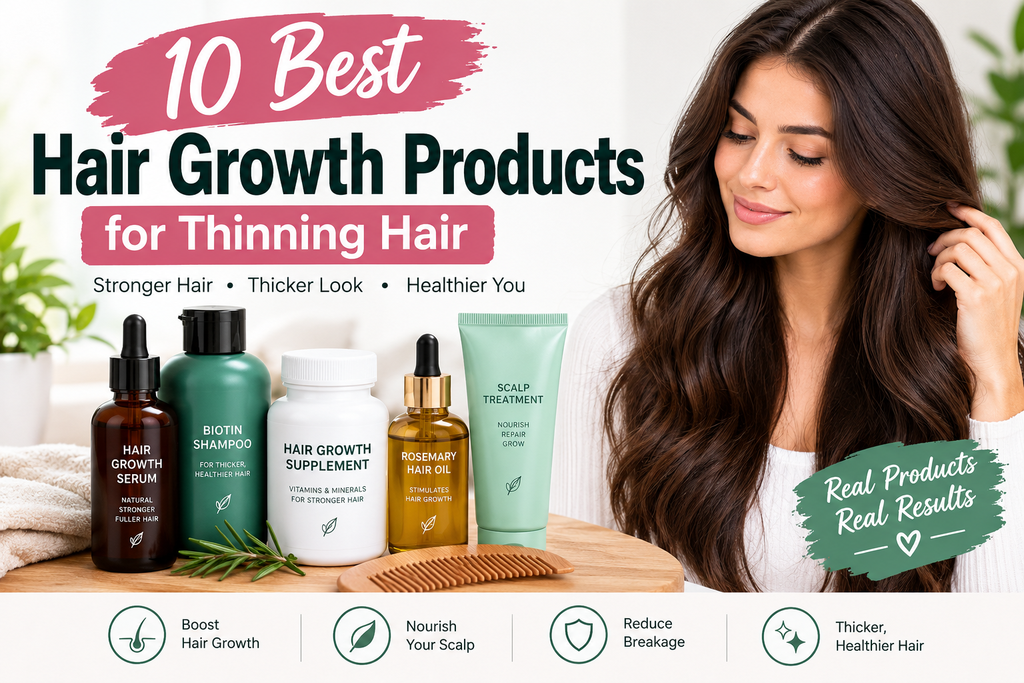
Hair thinning is common, and the products marketed to treat it range widely in how well they’re actually backed by evidence. Some — like minoxidil — have decades of clinical research behind them. Others, particularly many supplements and botanical treatments, have thinner evidence but can still play a supporting role in overall hair health. Here’s a rundown of ten of the most-recommended options in 2026, organized honestly by how well-supported each one actually is.
A quick note before the list: Dermatologists consistently point out that most shampoos, oils, and serums can improve hair texture and scalp health, but the products with real evidence for actual regrowth are a much shorter list — mainly minoxidil and, by prescription, finasteride. If you’re experiencing sudden, patchy, or significant hair loss, that’s worth a conversation with a dermatologist before trying products on your own, since thinning can sometimes signal an underlying health issue worth ruling out.
1. Minoxidil Topical Solution (Rogaine or Generic 2%/5%)
Minoxidil is the most clinically established over-the-counter option for hair regrowth, and it’s the one ingredient nearly every dermatologist points to first. The 2% formula is generally recommended for women, while 5% is more commonly used for men, though a doctor can advise on the right concentration for your situation. It’s typically applied once or twice daily, and consistency matters — results generally take a few months to become noticeable, and benefits reverse if you stop using it.
Best for: Anyone looking for the most evidence-backed non-prescription option to start with.
Worth knowing: Some people experience temporary increased shedding when they first start using minoxidil, which dermatologists note is a known, common side effect of the hair cycle resetting — not usually a reason to stop, but worth discussing with a doctor if it’s alarming or persistent.
2. Prescription Finasteride
For men specifically, finasteride is an FDA-approved oral prescription medication that blocks the hormone (DHT) most associated with male pattern hair loss. It’s one of the few options alongside minoxidil with strong clinical evidence for actual regrowth, not just improved hair appearance.
Best for: Men with pattern hair loss who’ve discussed options with a doctor — this one requires a prescription and isn’t appropriate for everyone (notably, it’s not used in women who are or may become pregnant).
Worth knowing: Because this is a prescription medication with potential side effects, it’s not a self-directed purchase — talk to a doctor or dermatologist about whether it’s right for you.
3. KeraFactor Shampoo & Conditioner
Originally available only through dermatologist offices, KeraFactor’s peptide-based shampoo and conditioner has become one of the most recommended non-medicated options for supporting thinning hair, using a proprietary complex of polypeptides and amino acids designed to support the scalp and existing follicles.
Best for: Someone who wants a dermatologist-associated product but isn’t ready for a prescription-level commitment.
4. Nutrafol Hair Growth Supplement
Nutrafol is a drug-free oral supplement built around addressing some of the underlying contributors to thinning — stress, hormonal imbalance, and nutritional gaps — using ingredients like ashwagandha, which has some clinical support for reducing stress. It’s formulated separately for men and women, and manufacturer-cited results typically take three to six months of consistent use.
Best for: People whose thinning may be tied to stress or general wellness factors, used as a complement to (not a replacement for) evidence-backed treatments like minoxidil.
Worth knowing: Supplements are not FDA-evaluated for treating hair loss the way minoxidil and finasteride are, and results vary significantly between individuals — talk to your doctor before adding any supplement, especially if you take other medications.
5. The Ordinary Multi-Peptide Serum for Hair Density
An affordable, peptide-based serum from a well-known skincare brand, this is a reasonable low-cost entry point for people just starting to notice thinning. It’s worth setting expectations correctly, though: it’s a standalone serum, not a full regrowth system, and it doesn’t contain minoxidil or other clinically proven regrowth ingredients.
Best for: Budget-conscious beginners wanting to add a scalp-supportive step to their routine, not as a primary treatment for established thinning.
6. Laser Cap or Comb Devices
Low-level laser therapy (LLLT) devices, sold as caps or combs, use red light to stimulate hair follicles and have some clinical research behind them, particularly for early-stage thinning. They represent a higher upfront cost than topical treatments but require no daily application beyond periodic use sessions.
Best for: People who want a device-based approach and are comfortable with a higher upfront investment in exchange for a low-maintenance routine.
7. DHT-Blocking Shampoo
Shampoos formulated with DHT-blocking ingredients (like saw palmetto or ketoconazole) target one of the underlying hormonal contributors to pattern hair loss at the scalp level. Evidence for shampoo-delivered DHT blocking is generally weaker than for oral options like finasteride, but it’s a reasonable low-risk addition to a broader routine.
Best for: Adding a supporting layer to an existing regimen, rather than as a standalone treatment.
8. Botanical/Natural Hair Growth Sets
Brands offering chemical-free sets built around botanical extracts, vitamins, and minerals appeal to people who want to avoid synthetic ingredients. It’s worth being clear-eyed about these: they generally lack the clinical backing of minoxidil or finasteride and tend to be better suited to early-stage thinning or general scalp health support than more advanced or hormonally driven hair loss.
Best for: Early-stage thinning or general hair health maintenance, not a substitute for medical treatment if loss is significant.
9. Biotin and Hair-Focused Multivitamins
Biotin supplements are widely marketed for hair growth, though it’s worth noting that clinical evidence mainly supports biotin helping people who have an actual biotin deficiency — a relatively uncommon cause of hair thinning for most people with an otherwise balanced diet. That said, general hair-focused multivitamins covering iron, vitamin D, and zinc can help if a nutritional gap is contributing to your thinning.
Best for: People who suspect (or have confirmed via bloodwork) a nutritional deficiency is playing a role — a blood test is a more reliable way to find out than trial and error.
10. Scalp Massage Tools
A low-cost, low-risk addition to any routine: scalp massagers are used to improve circulation to hair follicles, and some small studies suggest regular scalp massage may support hair thickness over time. It won’t replace a clinically-proven treatment on its own, but it’s a reasonable, virtually risk-free habit to pair with other steps.
Best for: Adding a simple, relaxing habit alongside more evidence-based treatments.
How to Choose
- Start with what has the strongest evidence. Minoxidil (and finasteride, for men, by prescription) are the options with the most robust clinical support for actual regrowth. Everything else on this list is more reasonably framed as a supporting habit or early-stage option.
- Give any product real time before judging it. Most legitimate hair growth treatments take three to six months of consistent use before results become noticeable — switching products too early is one of the most common reasons people conclude “nothing works.”
- See a dermatologist if thinning is sudden, patchy, or significant. Products bought online can’t diagnose an underlying cause (thyroid issues, iron deficiency, hormonal changes, certain medications), and a dermatologist can help identify whether something beyond routine thinning is going on.
The Bottom Line
If you want the option with the most established evidence, minoxidil is the reasonable starting point, with finasteride as a doctor-guided option for men. Everything else on this list — supplements, serums, devices, and botanical products — can play a supporting role in scalp and hair health, but it’s worth going in with realistic expectations about what’s proven versus what’s promising but less established.
This article is for general informational purposes and is not medical advice. Hair loss can have many underlying causes; consult a dermatologist or healthcare provider before starting any new treatment, especially prescription medications or supplements.